Join this Group for Updates and Discussions on this Blog (and a few others)!

Google Groups Join
Showing posts with label governement. Show all posts

Wednesday, January 02, 2008

New Year thoughts...

What was 2007 for India?

New year brings different kinds of messages. There are doomsday predictors and optimists galore. The most striking greeting I received was one penned by Narmada Bachchao Aandalon, Ms. Medha Patkar and team, it articulated the helplessness felt by many groups and the need for such groups to stay together. There was also prediction of widespread social disturbance and food insecurity in 2008, higher inflation, etc. One news report mentioned that no less a person than the PM himself has acknowledged that 2008 could be a tough year.

On the optimistic side, there are many friends and organizations sending on-line and off-line greeting cards and wishes, perhaps oblivious to the lurking dangers of the year ahead. Their ignorance is the promise.

I think 2007 was a year that established few issues at the national level -
1) increase in anger among sections of society and actions, mostly violent, guided by them at the cost of everyone else.
2) divorce of the state from the affairs of people.
3) indifference towards immediate neighbourhood by a large section of greedy population (mostly middle class).

Whatever social discourse seems to happen is happening between an angry mob-minded and often isolated, but, active groups and individuals negotiating with a state machinery which is impotent to people and a inert third section of the population that would be admiring the cheese in its pizza even if bullets are flying all around.

How did no one in the neighbourhood know of the ghastly killings of Nithari?
How come people repeatedly restore to violence in every case of public expression of asserting either self-image or discontent all over the country - whether it be Dalits being beaten to death in Haryana, Tribals in Assam, Nandigram, ...and the growing and ever spreading Maoist popularity?
How come the perpetrators of the Gujarat on camera accept (indeed proclaim) their crime and their neighbours don't protest the next day?

Rage grew across the country in 2007. It became a social advantage. In individual lives too, we are becoming an enraged people. In a recent journey on an autorickshaw in chennai, the driver had to swerve suddenly to avoid a pot hole which disturbed the biker coming too close behind, the biker sped alongside (thanks to the very powerful bikes all the time being introduced in the market) within seconds and started shouting at the driver of the autorickshaw, the auto driver in response almost drove his vehicle (with poor me inside not still reconciled to what is happening) onto the biker and the abuse continued for the next one minute of the journey...neither wanting to dis-embark from the security of their respective vehicles to resolve the issue, both building up rage to a crescendo with no reason, neither having the humility to apologize nor the mind to realize that the problem was of the road to begin with...this is a daily show, played out in various ways by different players across India, but, neverthless, being played out to make a un-healthy nation.

The divorce of the state machinery from the people's agenda was best summarized this year by the statement of the civil servant, a secretary of the central government at that, who opined that as the price of land will be much higher with the growth of SEZ than what the farmer may ever earn in his life, it is better he sell it and move on, vacate his land and go other places, do other things. The state machinery has become a property of different corporate holders and their beneficiaries. It works for them and prefers to address its own votaries as customers of the corporate clients rather than citizens of an ancient civilization. Growth is the share market index and power is the amount of investment. Such indifference and insensitivity to people not even the Colonial masters would have imagined the state machinery they designed would be capable of delivering.

The growing middle class is the inert population that satisfies itself with the comfortable crumbs from the initiatives of the state machinery and stays away from the violence of a suppressed people while debouching its own discontent through extreme consumption.

Welcome 2008.

I am an optimist, maybe, this year will see fewer farmer deaths, maybe the state will change its thinking, maybe there will be fewer SEZs, maybe industries will suffer from bouts of guilt, maybe the middle class will look around and take note of what happens in its neighbourhood, maybe...India is too old and too wise, it will assert, hopefully without much violence. Maybe the enraged people and estranged nation state will come together in some sane platform for everlasting peace. Prayers, Peace and Wishes.

Friday, October 26, 2007

More on the Indo-US Deal


I had earlier promised not to post further on this issue. But, it does not seem to leave us at all. The Americans want it, the PM is willing to sacrifice the government at one time and only his chair at other time for it (nothing is clear and neither seems to be happening, poor Deva Gowda). The Congress wants it, now, BJP too seems to want it (so if there is a chance of them coming back, it would come up again) and the US Ambassdor is talking to them too. Only the Communists are between the deal and the Nation, bless them for that. Here is one more news item that calculates the economics of the deal -

American Interest in Nuclear Deal by B.S.Raghavan in Business Line

...India’s plans of installing 40,000 MWs of nuclear power in the next 20-30 years, it is clear that the nuclear deal will mean a business of $80 billion for the lucky ones who win the contract. Allowing for the price escalation in later years, the figure may even exceed $100 billion, enough to inject adrenalin into the economy of the countries in which the supplier firms are located.

Remember, this does not take account of the requirements of components and spares, financing of service and maintenance and royalties on technologies — all of which may assure a steady flow of $10-20 billion more for the supplier firms during the life-time of the reactors. Certainly not a prospect to be sneezed at. As regards the intangible benefits to the US, an article “America’s Strategic Opportunity with India” by Mr R. Nicholas Burns, US Under-Secretary of State for Political Affairs and the point man for all that concerns the nuclear deal, published in the November-December issue of Foreign Affairs, gives an authentic exposition.

First and foremost, the deal is calculated to serve the national security interests of the US by bringing India into the international nuclear non-proliferation mainstream; second, it “will not assist the country’s nuclear weapons program in any way”; third, it gives the US control over the newly-to-be-built facility to reprocess spent fuel as it can operate only as per the specific arrangements and procedures laid down by the US; fourth, “should India decide to conduct a nuclear test in the future, then the US would have the right under US law to seek the return of all nuclear fuel and technology shipped by US firms”; and, finally, “an increasingly powerful India represents a singularly positive opportunity to advance (the US) global interests”.

Why would the US not pitch for it?

Friday, July 27, 2007

The Pakistan Question: Who after Musharraf?


Pak Army advises Mush to quit Friday, July 27, 2007 10:37 [IST]
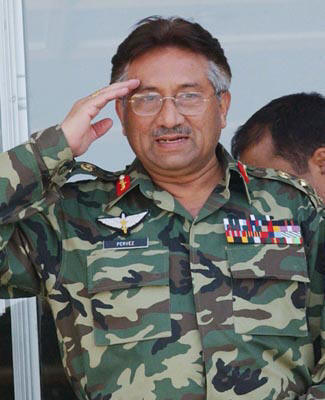
Islamabad: Pakistani President Pervez Musharraf has been advised by his top military commanders to quit in the wake of the restoration of Chief Justice Iftikhar Chaudhry, a daily reported today. During his six-day long discussions with his top military aides in Rawalpindi after the reinstatement of the Chief Justice by the Supreme Court, Musharraf was advised to seek an "honourable exit".


The above news item caught my eye and concern. With its fight between progressive Muslim groups and fanatical Mullahs and terrorist groups who stay in Pakistan as their home, the lack of any visible and credible democratic leadership in Pakistan needs to worry many in India also.

Musharraf has to perhaps take the same exit as his military predecessors, that is the law of military rule, but, are we going to witness another medieval minded army man who will yet again succumb to the easy temptation of anti-Indian sloganeering to further his rule? The restoration of the Chief Justice was a message that the legal mechanism is certainly willing to flex its muscle even against a military ruler. But is this indicative of a larger political mood? If democracy is restored whom does Pakistan have to show case, the corrupt Nawaz Sherief and the equally corrupt Benazir both cooling their heels in exile.

Permitting the current development perhaps is a willing gamble on the part of Musharraf to exhibit his tolerant nature to the western powers on whose support the government of Pakistan largely relies upon. Primary to the changes in Pakistan will be to understand what are the designs on Pakistan for the existing and emerging super-powers, USA and China respectively. The US government is used to treating Pakistan as almost its own territory, they have reserved the right to strike any 'terrorist' location within Pakistan, at the same time also asking Pakistan government to ensure no support is given to the terrorist groups (“Al Qaeda remains a potent force inside Pakistan, as is the Taliban,” said Mr Burns, the State Department's point man for Pakistan and India. “And we want to see Pakistan use all tools at its disposal to choke the flow of funds to terrorist groups.”). If the US has decided to choke the fund flow, then that would be the biggest choke of all.

A stable government in Pakistan I believe is for the benefit of India. It is time that the stupid rate race of missile development, which is nothing more than crude jingoism, is stopped by both the countries and an environment is created where other issues can be resolved. The overthrow of Musharraf is only of academic interest, but, more important for us in India is who will be the new power, the military again, some conservative with a soft corner for the fanatical mullahs or someone who can set the democratic process in better condition. Keep your fingers crossed and watch the developments in Pakistan for the next few months, there is certainly a change in the offing.

Read by Label