Join this Group for Updates and Discussions on this Blog (and a few others)!

Google Groups Join
Showing posts with label development. Show all posts

Wednesday, April 07, 2010

What price the 76 (or more) policemen lives?


First, the massacre of the policemen in such a large number is an act of violence that needs to be condemned and the people behind the attack need to face the law of the land whether they believe it or not. These policemen were also citizens of this country and except that they were in the wrong place and time doing their duty the way they were directed to do, they had no reason to die. It is unfortunate and dangerous precedence.

The '76 policemen' will remain just that in the coming days, while we know the names of each of the military men that died during the Mumbai terror attack, we won't know the names or backgrounds of the policemen who died yesterday morning. They don't make a good story beyond the first few days. No one wants to know the details of those who are defeated. They too are the victims of the State, but, they will not have celebrity authors visiting them and writing long stories either.

The Ministry of Internal Security, under the Home Ministry has been going through several changes in recent times. P. Chidambaram (PC), has taken his own image more seriously than any one else. No one is asking for his head to warrant those media friendly statements few days back that sounded more like G.W. Bush's rant rather than an Indian Home Minister. (Madhi got it right as usual in his cartoon yesterday, the three monsters behind PC while he talks about rooting out Naxalites in two years are labelled 'unemployment', 'corruption' and 'poverty' and the label in the podium reads, '52 years of Congress rule' courtesy: Dinamani). Today, as I write this, he has already hinted at using Air Force against Maoists, what next, Carpet Bombing in Sri Lankan style and a victory speech atop an air ship with mining company logo?

The issue is Maoists are not visible terrorists, they merge into the invisible angry citizen mass. These are the State's angry citizens, armed because of the State only recognizes violence and these arms are available to them rather freely through a few who espouse this ideology. 

The State can stop people getting angry with itself by being more sincere with its 'development' agenda, by replacing sops with genuine opportunities and most importantly valuing the rights of people over their resources. Both tribal rights activists and environmentalists are 'anti-development' in the books of  PC, who believes that the natural resources are there to be exploited. The exploitation of the poor for the betterment of the rich is an old large war, India had some amazing social systems that by-passed this to benefit both. But, PC won't know, he thinks any Indian history that talks of a better time is all humbug, he is not going to respect or refer any tradition or culture to understand social inclusion. Yesterday's newspapers carried a half page advertisement from the Home Ministry as proof. Obviously, the citizen is angry.
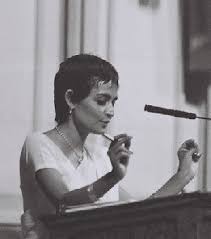
You can have peaceful methods of listening to the angry citizen. It is not always that the angry citizen has to resort to violence as a means to be heard / noticed. It need not be. But, how much is the State listening to Himanshu Kumar or Arundathi Roy? Beyond ridicule what has the state offered to these people? Every naxal attack is followed by 'what will the intellectuals say now?' debate, as though the intellectual condemnation or approval has any respect either for the State or for other perpetrators of violence. Why should the MoU between the State and Mining Companies be kept secretive? Does the State listen to a peaceful protest of a citizen, if the citizen is not backed up by either the power of money, media or visible majority? Does it understand the voice of justice? The angry citizen thinks violence is the only medium the State recognizes.

You can stop illegal arms production, you can ensure that arms are not smuggled across your border, you can ensure that the chemicals that are raw material for arms are strictly regulated and ensure that these are not freely available. But, that would mean rooting out corruption in governance, which cannot be done. You may point out that they have no legitimate right to carry arms or kill, but, your government has shown that this can be done by the rich and no law of the land can reach them, time and again. Someone for his own benefit in this government, at some level is permitting the few Mao followers to smuggle a lot of weapons that can be distributed to angry citizens whose' peaceful protests you don't recognize. 

One thing I am sure, Indians cannot buy into any alien ideology whole heartedly or for a long period of time. The claim of Maoists that they will overthrow the State is stupid. Arundathi Roy in her article in Outlook last week chronicles the tribal culture and its manifestation in the camps of the Maoists, that is ideologically contradictory. This is the land of Gandhi and Gandhi lives in the attitude of the masses, given a chance between peace and war, the citizen would gladly take peace and that is the proof. So, if there are ideologues out there in the jungle, I am sure they are no better than the ideologues in Kolkatta or think tanks in Washington/Beijing or virtual groups in the web or others hiding in caves of NWFP, they are all equally unsuccessful in trying to convert the Indian masses into a single ideology of violence, some people can buy into it for some period of time to suit their own purpose. But, it is time bound and will not work in India.  I cannot see a Maoist State of India.

PC needs to step down, not from his power, but, the moral authority that he has granted himself vis-a-vis the Naxals. It can only push him in the path of more State violence against Maoists while seeking them to abjure violence all the time. He also needs to not succumb to the media pressure that personalizes the issue as though he is s Superman and this is his time to deliver or vacate the space for another Superman. Making statements like the one he made are neither warranted nor wise as he may have realized by now. But, the politician in him may not permit that. Maybe, he should step down to a humbler man? 

What would Gandhi have done under the circumstances?

Maybe visit the 76 houses that have lost a son, a husband, a father or a brother in full media glare and seek their forgiveness for the government's stupidity in sending them to an area so unprepared. Seeking their help to non-violently fight the menace of terror. Break the chain of terror in the hearts of the colleagues of those killed by talking about peace. If he had the power, remove all policemen from that area immediately. Maybe even seek the nation to go on a day of repentance and peace. Maybe, he would also sit on a indefinite fast in the middle of the jungle against all armed violence and request Arundathi Roy to visit him!

Monday, March 16, 2009

Death of the Indian Village or another failed World Bank pronouncement?

Recent World Bank pronouncement that development is best if it were to  increasing Urbanization and Migration to urban areas, has come as no surprise. If the Bank will have its way, India should stop worrying about its villages and start concentrating on the urban areas. So, schemes such as NREGA that seem to promise minimum wages against jobs and asset creation in villages is waste of resources. Though I don't exactly accept the current formulation of NREGA (you can check out my take about it here), I think the Bank has just written its will. 


Government of India has been a sucker for WB projects and pronouncements, so what does this pronouncement (and its timing, just when the political parties are releasing their poll manifesto) imply to our politicians and bureaucrats? Would they re-align their priorities and policies with the WB recommendation? Will they know-tow the WB agenda? Would they also say, that the Indian village should die now? 


Indian village as  a backward and unnecessary appendage to the urban based and globally connected developed India is not a new discovery, Marx said it ages back, others influenced by his thought did think so both in India and from the West. Colonizers wrote theories on it, when free, we tried to base many policies on it. The debate is whether WB dictated mega-cities are the future of India or does the idea of Indian village still valid? We will see some interesting response to the WB I do hope, most importantly from the political parties. 

Wednesday, May 21, 2008

what does the lopsided development do...

An interesting news item below:

Around noon, the officials stopped a high-end black Mercedes that was going above 120 km per hour, well above the permissible 80 kmph limit. The moment officials confronted the car’s uniformed driver, a well-dressed middle-aged woman coolly asked the officer what the amount she had to pay as fine was. The cops told her that the penalty was Rs500. She took out two crisp notes of Rs500 denomination and handed them over to the officer. She said, ‘One note for this offence, the second is for the next one which I will be committing after you let me go.”

While the cop was writing down the receipt, the lady in the back seat lowered the window glass and said, “By the way, I did not buy this Mercedes to drive at 80 kmph on the super Expressway.” In a flash, the Mercedes was out of sight, roaring down the road to Pune at a high speed.

Even as the bewildered cops were busy discussing the woman’s attitude, another group of officers stopped a Skoda Octavia, which apparently was going at 150 kmph. A tall, young man came out of the silver car and wanted to know the reason for him being stopped. On being told that he was speeding, the man burst into a hearty laughter. “High speed, are you kidding me? I am from the United States. Over there, we drive at 120 mile per hour. Your 150 km per hour is nothing compared to that,” he bellowed.

Source: Just Samachar - Read the full story by clicking the link

The lopsided development in this country means that people can afford Merc and drive at high speeds with no reverence for the law of the land and if the law objects, it can easily be bought over. The exposure to foreign lands and its culture combined with affluence and an unwritten agreement that the foreign land is better means that any regulation that is different from that can be dismissed off. Both are clearly seen in this news report.

Wednesday, August 15, 2007

Independence Day Morning

Sixty years of Independence, rough roads reflect the ups and downs,
Newspaper is large this morning 60 extra pages of words,
Delivered by the same boy, same cycle, same road.

Tuesday, June 05, 2007

World Environment Day, 2007

What does it mean to us in India?

While the developed world starts to watch its over obese waist line and wants to cut back on its carbon emission, thinks up cheap ways of balancing its consumption such as carbon credits, wants to calculate and reduce even environmental consciousness into a number to measure oneself against and hence feel less guilty ('you know I scored rather well above average in my personal carbon foot print this week, better than most of my neigbours, I am happy'), we in India want to turn every green patch into a concrete foundation if possible.

Our obsession with attracting FDI and facilitating FDI in just about everything, to ensure that those who bring in the solemn FDI can have it easy in every way, that they are provided with the land, water, mines, people, government, ministers, corruption and whatever else they require even before they say a word is today the greatest destructive force against our environment. Our bureaucrats are its carriers and mouth pieces. Our press sees no contradiction to carry news only few days back on the high speed land purchase running to several hundred hectares by MNCs for yet another SEZ promotion and also carry page long 'dedication' to green causes this morning. After all increase in their business and increasing number of pages is a direct affront on trees.

Notional planting of a tree is all that the political bosses have done for many years and as the famous joke goes, maybe they are planting in the same spot every year. Trees disappear in cities and highways in the name of road or building expansion. Chennai's green cover (such as it is) has been challenged like never before through the current road expansion. Some green groups have reduced even planting of trees to number game, there was a celebrated guru planting 'lakhs' of saplings in one day, how many survived is doubtful. Maybe Gurus who promise instant nirvana also think they can create overnight forests. The traditional conservation activities in temples and common lands may only remain part of a memory.

Perhaps ten years back those who spoke of 'development', many NGOs in particular would talk about 'green', 'environment', 'sustainability' as a value that was easy to understand. Currently with the advent of the 'market', these are all but disappearing. 'Market integration' of their 'developmental' agenda has taken over as a priority among many in this field too. Fuel, particularly bio-diesel has crowded the discussions in many environmental discussion groups as a matter of livelihood to communities, the environment in which the communities have dropped from the agenda. The entire perpetuation of the carbon credit has been latched on to by many in the development sector as an opportunity to attract sure money.

Our development today is at the cost of environment and as Gandhiji mentioned, if India ever desires to live the life of America, then all the resources in the world also cannot be enough. But, that is precisely what we are working towards, eventually we may declare that the problem is too many of us, and as the popular columnists TJS George points out, there may not be too distant a future when we start questioning why not reduce the people cover a wee-bit in some non-productive sectors (similar to bringing down tree cover today) so as to bring down needless consumption!

Wednesday, May 30, 2007

A Sincere Ministerial Admission: Read Mani Shankar Iyer

I always remember Mani Shankar Iyer for being the man who wrote all those one liners for Rajiv Gandhi. If my memory is correct, Iyer came to prominence (or notoriety depends how you see it) by being part of the new young brigade around Rajiv Gandhi. Many of that group are no longer active in the Indian politics, Arun Nehru, one doesn't know where he is, long since I saw his columns in insignificant news papers, Arun Singh was last heard of during Kargil when he was brought out of self confinement to advise the defense ministry, Iyer is currently relegated to an insignificant post in the ministry away from the lime light reducing the opportunity available to exhibit his one line acumen. I realized that he is not very popular with the current powers and perhaps is retained due to courtesy. (By the way, I think he is one of the best MPs today in Tamilnadu, I have spoken to many sections of people in his constituency and almost everyone has something good to say of him there).

Then I got to see this speech by him, rather sincere and circumspect. Under all the celebration that goes on about the 'growth' and 'development' this is a reality check that is worth reading -

Source: http://www.indianexpress.com/story/29112._.html

‘I was always Leftist. Economic reforms made me completely Marxist’

Mani Shankar Aiyar

A few weeks ago the newspapers reported that the number of Indian billionaires had exceeded the number of billionaires in Japan, and there was a considerable amount of self-congratulation on this. I understand from P. Sainath that we rank eighth in the world in the number of our millionaires. And we stand 126th on the Human Development Index. I am glad to report that last year we were 127th.

At this very fast rate of growth that we are now showing, we moved up from 127th to 126th position. This is the paradigm of our development process. In a democracy, every five years the masses determine who will rule this country. And they showed dramatically in the last elections that they knew how to keep their counsel and show who they wanted. We, my party and I, were the beneficiaries and we formed the government. Every five years, it is the masses who determine who will form the government. And in between those five years the classes determine what that government will do.

In determining what that government will do, the CII has played an extremely important role. I am not surprised, as that is its job. It represents industry, and therefore it argues for the interests of the industry. Industry has been enormously benefited by the processes of economic reform that we have seen in this country over the last 15 years or so. But the benefits of these reforms have gone so disproportionately to those who are the most passionate advocates of reforms that every five years we are given a slap in the face for having done what the CII regards as self-evidently the right thing for this country.

It is a sustainable economic proposition, because our numbers are so vast, that there are perhaps 10 million Indians who are just as rich as the richest equivalent segment anywhere in the world or in any group of countries. There are about fifty million Indians who really are extraordinarily well off. That’s the population of the UK.

But if you look at the 700 million Indians who are either not in the market or barely in the market, then the impact of the economic reforms process, which is so lauded by the CII, makes virtually no difference to their lives. That is why there is a complete disjunct between what the democratic processes are trying for in the short run and what those who have made an enormous success of our achievements in the last fifteen years deem to be, at least in the short run, their own requirements.

So when you talk of a nine point two per cent growth rate, it becomes a statistical abstraction: 0.2 per cent of our people are growing at 9.92 per cent per annum. But there is a very large number, I don’t know how many, whose growth rate is perhaps down to 0.2 per cent. But certainly, the number of those who are at the lower end of the growth sector is very much larger than those who are at the higher end.

Yet what happens when you have the budget? As an absolute ritual every finance minister (my colleague Chidambaram is no exception) will devote the first four or five pages of his budget speech to the bulk of India and there will then be several pages, including whole of part B, which deals perhaps with one or two per cent of our population. Almost the entire discussion that takes place at CII or CII-like forums, will be about Part B rather than Part A.

There are comfort levels that you get from statistics — for instance, suddenly Arun Shourie, announcing in the NDA government that our poverty rates have fallen from 35 per cent to 22 per cent. He did it by changing the basis on which you estimate poverty. You cannot compare apples and oranges. The next national sample survey has shown that our poverty levels have actually increased. Are we going to be mesmerised by these statistics or understand that 700 million of our people are poor?

So we have an Indira Awaas Yojana which will ensure that there will be a ‘jhuggi’ for every Indian round about the year 2200. We have the PM Gram Sadak Yojana which was supposed to complete all the gram sadak in seven years — we are in the eighth year. And where we are told that the education of 1000 may be covered, who knows only the education of 500 will be covered. And if you happen to be a tribal in Arunachal, you are told that because of your social custom you are to live in one hut atop a hill, we can’t provide you a road.

I was always something of a leftist. But I became a complete Marxist only after the economic reforms. Because I see the extent to which the most important conception of Marx — that the relationship of any given class with the means of production determines the superstructure — holds.

This ugly choice is placed before the government. An unequal choice, because you have organised yourself to say what you want to say but the others are only able to organise themselves and that too without speaking to each other in the fifth year when the elections take place. That is why this expression anti-incumbency, although the Oxford Dictionary says that it is a word belonging to the English language, is a peculiarly Indian phenomenon. Because everything that goes in the name of good governance like the economic reforms either does not touch the life of people or affect them at all.

We have seen what happened at Nandigram, we have seen what was happening at Singur and we have these propositions that say that SEZs are going to come and lakhs of hectares are going to be utilised for the good of the country. For what’s the syndrome in all this, it’s still ‘do bigha zameen’. The chap says that I want my one bigha of zameen to be reinstated, but you offer double the compensation and “baad mein dekha jayega”. You go to Hirakud, which is where Jawaharlal Nehru actually used the expression modern temples of India, and you ask what happened to the tribals who were driven out of there. Absolutely nobody knows.

Coming to the cabinet, you see what happens. The minute suggestions are made as to what would perhaps benefit the people and what would benefit the classes, the tendency is to say that our great achievement is 9.2 per cent growth. Our great achievement is that Indian industrialists are buying Arcelor and Corus. That Time magazine thinks we are a great power.

In these circumstances, when a proposal came before the government to spend Rs 648 crore on the Gram Nyaya department, we were solemnly informed by one of the most influential ministers in the government to remember that we are a poor country. I was delighted when the next day he was with me in a group of ministers and I reminded him of his remark and said in that case can we stop spending the Rs 7000 crore on the Commonwealth Games and he said, “No, no, that is an international commitment and a matter of national pride.” This national pride will of course blow up if you spend Rs 7000 crore on the Commonwealth Games. We will be on the cover of Time and Newsweek.

I have always wondered why this rate of growth and economic reforms process is dated to Manmohan Singh. Because actually it should be dated to L.K. Jha’s book Economic Strategy for the 80s. It is the decade in which we quickly recovered from agricultural depression and registered a double digit growth. At the beginning of the decade our biggest import was crude oil and after that it was edible oil. By the end of the decade we were exporters of several kinds of edible oil.

Why is it that Nehru became successful with his Hindu rate of growth? The reason is that the Hindu rate of growth was five times what our pre-Hindu rate of growth was. From 1914 to 1947, the figures of which are available, the rate of growth of the Indian economy was 0.72 per cent. And we got the Hindu rate of growth which was five times that and it made a difference to the people. The minute you had solid land reforms, the people had their ‘zameen’. That is what Mother India was all about. People felt that they were involved in the process. All the political talk was: gareeb ke liye ham kya kar sakte hain. Indira Gandhi matched it beautifully when the entire political spectrum joined hands against her by saying, “Woh kehte hain Indira hatao, hum kehte hain Garibi hatao.”

There is nobody so marginal in a government as the minister of Panchayati Raj. I count for nothing. Nothing! When I was the minister of petroleum, I used to walk surrounded by this media. I kept on telling them that petrol prices can do only three things — go up, go down or remain where they are. And it was all over the place. But try and get them to write two words about the 700 million Indians — absolutely impossible. And now with terrestrial television it is even worse. You have to be quarreling with your mother-in-law or hitting your daughter-in-law to be able to hit the headlines. It is impossible to get particularly the pink papers to focus on issues that affect the bulk of the people. And it is so easy to get them to focus on issues that are of high relevance to only one or two per cent of the people.

I believe the CII, if it is serious about the issue, should not be restricting itself to 25 minutes discussion before lunch but hold discussions for ten days and maybe something will come out of it.

Edited extracts from a speech at the CII Northern Region annual meeting 2006-07, New Delhi, April 4

Saturday, February 03, 2007

Photo-Blog: Traffic in Hyderabad

Was in Hyderabad and had the luxury of being driven around the town by three different drivers, all of them complaining about the traffic of this city. I am not writing much on it today, reserve it for some other time, but, wanted to share some photos I shot on Hyderabad traffic. So, this is a post with pictures to say stories.
Pic.1 - The story of development, roads being re-done, unfortunate statues of forgotten leaders being further abused by over sized hoardings, clue-less citizen cruising along...(Pic.2) while yet another flyover is to come up in front of more sky scraper hoardings...

While this is the environment for the traffic to operate, we come to the people in the traffic itself next...
Pic.3: Hyderabad police prescribe helmets from drivers not all riders, not many follow, with good reasons...here is a bike of a family of 6! How would they all fit with helmets?...and no body every follows the traffic lights...here (Pic. 4), look at the traffic light on the right corner and watch the large vehicle cutting from the left across the onward traffic...sab kuch chaltha hai spirit...

(Pic. 5) And the poor victims...pedestrians concerned (with an infant in this case) waiting patiently for the procession of merciless (and often mindless) cars to go past in every traffic crossing...(Pic. 6)...and commuters of public transport suffer the triple humiliation of no stand or shelter, having to withstand the road laying / relaying dust and rubble while they wait for the buses to arrive and with no demarcation , the traffic almost on their footsteps...

...and the ever present victims of urbanization across India (Pic. 7), those nameless persons who populate the footpath, live and die there and save much to the exchequer by not being a burden on it...(Pic. 8) not to mention the other major victims, which tries to see the silver lining in the opportunities of the economic growth, but, has to cope with the fact that it doesn't exist in the policy makers' mind the unorganized sector, here a fruit vendor, trying to navigate past crazy traffic...

Read by Label