Join this Group for Updates and Discussions on this Blog (and a few others)!

Google Groups Join
Showing posts with label organic. Show all posts

Wednesday, July 30, 2008

Indian farmers shun GM for organic solutions - Guardian report

The following is not a regular report as we find in our newspapers. We are still vary of comparing GM technology with organic farming. GM is seen as 'scientific' and organic seen as 'people knowledge', hence the two cannot be compared.  GM is corporate (hence professional) driven whereas organic is NGO (and thereby suspicion) driven.  This news item has not said anything not known to people regularly following the GM stories, but, the brevity of the title is powerful and needs to be taken note of. The quote in the end is from the friend who has forwarded the news item and not part of the article, but, so apt it is worth resending.
-------------------------------------------------------------------------------------------

Indian farmers shun GM for organic solutions
Sue Branford
The Guardian, July 30 2008
http://www.guardian.co.uk/environment/2008/jul/30/gmcrops.india

*Genetically modified cotton was to be the saviour of India's farmers, but ill-health and financial worries are fuelling a backlash*

"My family was one of the first to stop using pesticides," says Sattemma, a lively Indian woman in her mid-40s, confidently talking to a group of visiting farmers. "Three years ago, we realised we were spending over half our income on chemicals. It was too much. We were getting into debt and the pesticides were making us ill." Sattemma is in the village of Lakshminayak Thanda in Warangal district of Andhra Pradesh. The visitors are keen to know how she and other villagers are progressing after their decision to stop using pesticides and Bt cotton, the genetically modified variety manufactured by US biotechnology firm Monsanto.

Bt cotton was engineered to combat pests, with the introduction into the cotton seed of a gene from a soil bacterium called Bacillus thuringiensis (Bt), which has a natural insect-killing poison called Bt-toxin. When it was introduced into India at the turn of the century, it was promoted as the "wonder product" that would solve the serious problem of pests, which many of India's 17 million cotton farmers were facing.

Many of the farmers had not been growing cotton as a cash crop for very long. In the late 1980s, under pressure from the International Monetary Fund, India had opened up its strongly protected economy and encouraged its farmers to switch to modern farming, with its hybrid seeds, fertilisers and pesticides. The idea was to turn India into an important exporter of commodities, including cotton.

At first, cotton farmers did well. They got high yields and enjoyed a real increase in income. But then problems arose. The hybrid cotton proved susceptible to pests and diseases, and it was not uncommon for farmers to spray their fields up to 30 times in a single season. Production costs went through the roof and farmers got trapped in debt. They became desperate for a technical fix, and Bt cotton seemed to be the answer.

In its first year of sales, Mahyco-Monsanto sold its entire stock of Bt cotton. According to the company, the area in India under Bt cotton rose from 3.1m acres in 2005 to 14.4m acres in 2007. According to Sekhar Natarajan, regional leader of Monsanto India, Bt cotton yielded 700kg-900kg per acre, compared with 300kg-400kg an acre with conventional seeds.

However, some say that what has been happening on the ground has been very different from the official success story. Scientists Abdul Qayum and Kiran Sakhari assessed Bt cotton's performance in the first three years and found that, despite claims by the company, farmers were not achieving big yields. This perhaps was to be expected, because Bt cotton had been engineered to reduce pesticide use, not to increase yields. But, more surprisingly, they found that pesticide use was not falling either, because farmers were facing serious problems with secondary pests. They worked out that, on average, the income of non-Bt farmers was 60% higher than that of Bt farmers. Monsanto contests these numbers.

There have been other, more alarming problems. In her chat with the visiting farmers, Sattemma says she had seen several of her neighbour's goats die after spending all day grazing on post-harvest Bt cotton plants. Such a story could be dismissed as anecdotal, if it were not backed up by more solid evidence. In 2006, more than 1,800 sheep died in similar circumstances in other villages in Warangal district. The symptoms and post-mortem findings suggested that they had died from severe toxicity. Hundreds of agricultural workers had also developed allergic symptoms when exposed to Bt cotton.

Safety investigation

One might have expected such reports to have led to a thorough investigation into the safety of Bt cotton but, according to the US-based Institute for Responsible Technology, this has never happened. Again, Monsanto contests this account. According to Natarajan, Bt cotton was exhaustively tested for six to eight years before it was authorised for release and there were no reports of adverse impacts on the health of humans or animals.

Less controversial is the financial risk that Bt cotton, along with other hybrids, brings to small farmers. Farmers have traditionally saved seeds from one harvest to another, but this is not possible with hybrids, as they lose vitality. So farmers purchase on credit from middlemen a package of hybrid seed, fertiliser and pesticide, paying back the loan once the crop is harvested. The problems start when a farmer loses a crop through bad weather. Unable to repay, they can easily get caught in a debt trap. Problems were serious before Bt cotton but have got worse because Bt cotton seed is expensive.

Despite these problems, the Indian government believes that cotton has proved a success. In 2006, India overtook the US to become the world's second largest cotton producer (after China). The biotechnology industry is taking the credit, though some farmers are reporting new problems, saying Bt cotton is highly susceptible to wilt. On one occasion a Mahyco-Monsanto representative was taken hostage by irate farmers demanding compensation. More difficulties could lie ahead: a recent study by the Nagpur-based Central Institute for Cotton Research showed that the main cotton pest, bollworms, is becoming resistant to Bt cotton.

Many farmers, like Sattemma, have not followed the debate around Bt cotton. She says it was practical considerations that led to the change in farming. "It was the 15 women in our village's self-help group who got things going," she says. "We were worried about the health of our children. We got the men on our side by showing them that they would save money." Sattemma points to a chart on the wall of a nearby house, on which, with the help of a non-governmental organisation, they have recorded side-by-side the expenses of growing cotton with and without pesticides. Non-pesticide management (NPM), as the system is called, is clearly more profitable, not because yields are higher but because expenditure is so much lower.

In Yenabavi, about 30 miles away, the farmers have gone further, becoming organic and declaring their village GMO-free. Their conversion also began with dissatisfaction with pesticides, this time because they didn't work. "Ten years ago, this field was covered with red-headed hairy caterpillars," says Malliah, the farmer who has led the change. "I kept applying more pesticides but I couldn't get rid of them." By chance, an organic agronomist was visiting. He showed Malliah how to set up solar-powered light traps and, to Malliah's delight, they worked. Since then, he and the other farmers have developed other natural pest controls.

Other villages are following suit. Almost 2,000 in Andhra Pradesh have adopted NPM. Raghuveera Reddy, the state's minister for agriculture wants 2.5m acres under community-managed sustainable agriculture within a few years. The long-term goal is for 10m acres, 45% of the state's cultivable land.

Sustainable agriculture involves hard work and does not guarantee huge profits, but it will not harm the farmers' health, brings personal satisfaction, and involves fewer financial risks. It is crucial to remember what is truly sustainable for small farmers.

"It is now 30 years since I have been confining myself to the treatment ofchronic diseases. During those 30 years I have run against so many histories of littlechildren who had never seen a sick day until they were vaccinated and who, in the severalyears that have followed, have never seen a well day since. I couldn't put my finger onthe disease they have. They just weren't strong. Their resistance was gone. They wereperfectly well before they were vaccinated.. They have never been well since. "---Dr. William Howard Hay

Tuesday, May 06, 2008

Day for protest on GM Food

This morning the first thoughts were that later today there will be a group trying communicate to an uncaring nation about the dangers of permitting GM Food into our kitchen through a protest at New Delhi (in front of Jantar Mandir, 10 a.m.).

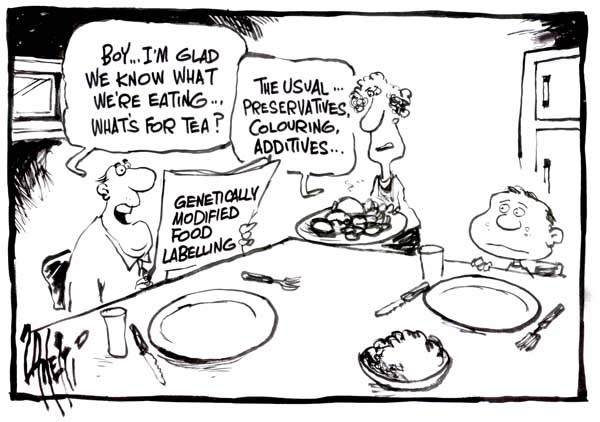
Genetically Modified Foods are a solution to a problem that is non-existent. Scientifically, Technically, Socially, Ethically, Economically and Environmentally it is a bad initiative. Yet it is being pursued for one single reason - it is commercially more secure for the companies who developed it. And these companies are today associated with the politically powerful nations who can dictate what ought to be done and not be done to solve global problems of both real and imaginative nature.

It is often said that the choice of 'data' is the prerogative of the person who uses it. All kinds of social, economic and political data have been used to promote this technology that has been founded on corporate greed.

Hence you find that the infestation of a certain pest (bollworm) and the consequent consumption of pesticides among the cotton farmers is a problem that ought to be addressed ONLY by inserting a gene of a bacteria on the cotton itself that will resist the pest. This is akin to saying that if you had a skin of a mountain goat you can withstand the cold in the mountains very well, so maybe humans in the mountains will need a goat's gene in their bodies, it will also save on the money people spend on the woollen. What is the issue, spending on wool? living in such tough conditions in the mountain? or reducing all solutions to the artificial transfer of the gene between species?

Suddenly, brinjals which are grown across the country in India and is cooked in a thousand different ways has become a crop in contention. Or the pesticide consumption of brinjal crop has become an issue - we are told that it too suffers from pest attacks and to resist pests, it needs to be secured through artificial bacteria gene inserted into its gene code. Similarly, across India children suffer from Vitamin-A deficiency, we are told that they urgently need supplements and what is best way to do it, of course, artificial gene transfer from a vitamin-A rich flower into whatever they eat, if their staple is rice, then we will insert it into rice, and pronto, we have the media savvy scientists proclaiming with bleeding hearts that they now have the 'Golden Rice' to save the blinding children of India.

Remember when last time a man took it upon himself to only maintain superior species in the world, we had the second world war. But, he was a stupid dictator, not a business man, when a business man wants to do the same, he doesn't waste time annihilating the not qualified, he just provides then with solutions to become better and makes money in the process. It was called fascism when a dictator does it, it is called by whatever name the business people want it to be known as now, because they are not any business people, they are the most powerful ones in the world too.

Did we not manage pests in cotton and brinjal plants without pesticides? Did we not know how to over come the problem of Vitamin-A deficiency in our children?

Across the state of Andhra Pradesh last few years farmers have proved through a process in thousands of hectares of land how without use of chemical pesticides they can manage their pests. A technique called NPM (No chemical Pest Management) that originated in the farmers' fields and till date has neither received any university or research organization's contribution to its growth! They have proved that it is possible to do pest management without pesticides very successfully. They have done this through many techniques that were developed by farmers who decided that they wanted to save on the money being spent on the chemicals unnecessarily.

Green leafy vegetables and papaya are some of the riches sources of vitamin-A in the world. There was a internationally funded project across India to promote the consumption of these by poorer communities by planting these in their neighbourhood, this project funding I am told suddenly stopped when the powerful gene-transfer agents started their bid to sell the gene-transferred rice to the Indian government. Even today this would be the easiest solution as both green leafy vegetables and papaya are available easily in most parts of the country. there are cultural issues that often limit people in consuming papaya, this can be addressed through awareness drive through the powerful visual media.

NPM, growing green leafy vegetables and similar such initiatives have on limitation. They transfer the power of the lives of the people to themselves, they make people self-sustaining and hence a threat to the global corporate agenda. The global corporate agenda today requires that life of anyone be lived in accordance with the marketing requirements of the companies. That we are aware of what are marketing requirements of different companies promoting various goods in our areas and adhere to their needs makes us a 'good' consumer citizen. If we resist, rebel or just refuse to use their goods, they we are 'not with' them. And their world view is divided simply as 'those who are with us and those who are not with us', as one of their big poster-boy neatly summarised it.

Hence the promotion of GM crops has been both presenting selective and convenient data to create a 'problem' situation that we were not aware of till it was presented thus to us and to rubbish any other 'solution' that comes from people who are not with the corporate agenda. One big beneficiary has been the media and the public relations industry, for they have been given the work of changing the perception of the world on this issue. Perhaps never before in history did a 'solution' need to be promoted with such large investment on publicity. But, never before in history did we have a 'solution' that also had to create widespread 'problems' so that it can sell itself.

As a farmer from a non-powerful nation, Indian farmers have limited choice. I was told that, Andhra Pradesh farmers this year found when they went to the shops to buy their cotton seeds that the only seeds stocked were the Bt Cotton seeds, almost in unison all the seed companies (most of them taken over or distantly owned or dictated by few global major corporates) and government seed units have ONLY stocked up Bt Cotton for selling this year. They don't have the negotiating power nor the economic might to fight this injustice. Soon, we the consumers will have even lesser choices. We will have the entire super market shelf stocked with GM Foods.

The problems that arise out of GM Food consumption is not yet fully known. Only recently one university has dared to state that a new form of disease that is spreading in parts of USA, which is inexplicable and un-curable could be possibly due to GM Food consumption. Only recently another university report states that GM Crops actually do not enhance the productivity. China has already suffered growth of giant weeds in GM fields. Environmentally, the presence of a non-natural gene-transfer across species organism affects other life forms around and disturbs the entire ecological balance, however, over stating any ecological concern today means being labelled 'eco-terrorist', a label that is most used in the GM debates to completely stonewall any further arguments on some issues.

While the PR force of the biotech majors rubbish everyone who counters them as a terrorist of one form or another, the scientists have come up with a convenient terms and explanations. So, anyone talking of a detailed testing or inconvenient data is dismissed literally at times from their jobs and as being 'un-scientific'. A new term, 'substantiative evidence' is used against 'precautionary principle' to sell the technology. In ordinary language it means, 'look we don't have adequate evidence that such and such a product could have such and such side effect, so, if you fear that it will have a unhealthy consequence and want to take precautions, that is not fair, after all there is not enough evidence, let is use it as wide spread as possible (and the corporates recover their investments) and then if there is adequate evidence (and there could be another opportunity to sell 'solution' to that 'problem') then we will see'. Of course it doesn't matter that in the process quite a bit of eco-system as we know today, agri-culture a it was practiced in many old countries and policies, people life styles and public opinions have to be modified, so what, these of are no consequence in front of the corporate greed and their power today.

We can make a difference. And the difference will start with our life style, our choice of the what we consume. Locally grown food, preferably organic and of local variety, brought through the local vendors, bought and home cooked (and not ready-to-eat off-the-shelf food) are the first small steps to stepping out of the corporate greed agenda that is GM Food. Of course, this means time taken off from our often busy schedules. This time invested by many adds up, it adds up to erode the corporate markets thereby their greed and ultimately changes their course. If we don't have that extra time to alter our food consumption habits, we may not have much choice tomorrow, it is estimated that almost 85% of the American food is GM Food, we are not that bad yet, but, it is not too far away too.

You may not take time to symapthize with those who protest against GM food crops in Delhi today, you can however choose to live healthy by simply investing that extra time for your own benefit and incidentally the world will benefit too, it is as good if not better than tax exemption for spending on yourself. It is our choice.

Read by Label